

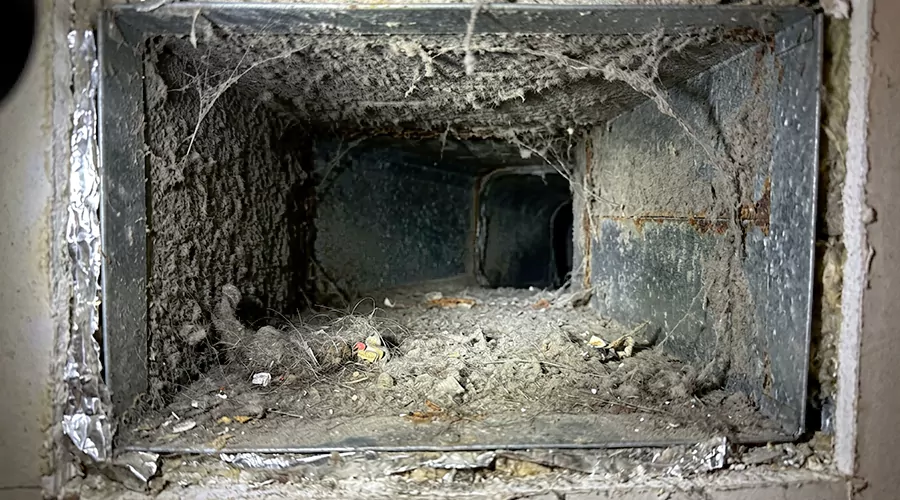
Dust in air ducts forms when tiny airborne particles settle on the inside surfaces of the duct system. Normal household air contains fibers and soil particles. Additional dust can enter through leaky return ducts or filter bypass gaps. The presence of dust alone does not mean the system is unsafe.
The key question is how much material has accumulated and whether it can reach occupied rooms. Dust attached to interior duct surfaces does not necessarily move into indoor air. Identifying the source matters more than setting a cleaning date.
Where Does Dust Inside Ductwork Come From?
Most duct dust comes from particles already in indoor air. People bring in soil on shoes, fabrics shed fibers and activity stirs settled material. Air returns draw that mixture toward the HVAC system. Proper filtration captures some of it while gaps can allow particles to continue.
Particles Already Circulating Through Rooms
Ordinary activities generate or stir dust throughout the day. The return system collects air from rooms and moves it toward the filter. Dust that escapes capture can deposit at duct corners and transitions.
Unsealed Connections in Dusty Spaces
A return duct running through an attic can draw outside-the-living-area air through openings. That air may carry insulation fibers or stored dust. Sealing the return path reduces the route without relying on repeated cleaning.
Improper Filter Installation
A filter that tilts or leaves a visible edge gap permits air to bypass its media. Higher-rated filters do not solve a poor fit. The HVAC manufacturer's filtration recommendations and correct dimensions are the starting points.
Construction Debris Left Inside Openings
Uncovered floor registers collect sawdust and drywall powder during repairs. Debris can drop into the first duct section even with the blower off. Remove the reachable material carefully rather than pushing it farther into the branch.
Does Dust in Ducts Get Worse Over Time?
Some dust naturally accumulates, but there is no established timetable that predicts harmful levels. Deposits vary with duct shape and particle sources. A sealed system with a sound filter behaves differently from ductwork with an open return joint.
| Observation | What It Indicates | Priority |
|---|---|---|
| Fine film inside metal duct | Ordinary settled particles | Check filtration and monitor |
| Thick loose debris | Possible source or maintenance problem | Find entry point and evaluate cleaning |
| Insulation fragments | Possible damaged liner or outside-air entry | Inspect material and joints |
| Damp debris | Moisture problem requiring action | Locate and correct water source |
Routine cleaning should not be assumed to improve health or eliminate household dust. Cleaning may be reasonable when there is substantial debris, pest infestation or confirmed significant biological contamination. Correct the underlying cause first.
What Signs Show That Duct Dust Matters?
The most meaningful signs connect a visible deposit with a real change in the system. Loose material blowing out of a supply grille is more informative than a dusty return cover. Track repeated symptoms and compare areas rather than judging one picture.
- Visible debris inside the supply duct close to the outlet.
- Particles are released into a room when the blower starts.
- The filter does not cover the full filter opening.
- A duct joint is visibly disconnected.
- Dust has collected heavily just past a recent remodeling area.
- A damp patch appears inside a metal duct.
- The system emits a persistent damp odor while running.
- A return grille collects new debris unusually quickly.
- You see signs of rodents around accessible ductwork.
- The same dust problem persists after normal housekeeping.
How Can You Inspect Dust in Air Ducts Yourself?
A safe inspection starts at a removable grille and the filter cabinet. You only need to observe reachable surfaces and document what you see. Do not cut into ducts or remove insulation. Dust color alone cannot identify its composition.
- Turn off the thermostat and wait for the blower to stop.
- Check the air filter for correct size and visible bypass gaps.
- Remove an accessible grille only if it can be safely reinstalled.
- Use a flashlight to view the nearby duct wall.
- Take a photo and note whether deposits are thin or loose and thick.
- Reinstall the grille before operating the system.
Avoid aggressive brushing of flexible or fiber-lined ducts. Their interior surfaces can be damaged. If you find damp insulation, do not disturb it. Record the location and investigate the source of moisture.
When Should a Professional Evaluate Duct Contamination?
An inspection is appropriate when dust is visibly blown into rooms or when heavy debris blocks the duct. Signs of pests and suspected substantial mold also need further evaluation. A credible recommendation should describe the contamination and explain how the source will be corrected.
An HVAC specialist can examine return leakage and filter bypass. If cleaning is needed, a duct specialist can use collection equipment designed to prevent debris from escaping. Request images of the actual affected sections rather than relying on a general claim that all ducts are dirty.
Wet or moldy internal insulation may need replacement because it cannot always be cleaned effectively. A moisture issue requires repair before any cleaning. Repeated treatments without source control will not resolve the original problem.
How Do You Limit Dust Accumulation in Ducts?
Limit dust by reducing particle entry and protecting the HVAC system during messy work. Regular filter care is useful because the return system moves household air every time it operates. Duct sealing matters most when connections are exposed to dusty attics or crawlspaces.
- Check filters monthly when the system runs often.
- Use the filter type and replacement schedule approved for the HVAC equipment.
- Vacuum return grilles and nearby surfaces during normal cleaning.
- Keep the system off and vents covered during major dust-producing renovation.
- Inspect accessible duct connections during maintenance visits.
- Deal with roof leaks and condensate drainage problems promptly.
Frequently Asked Questions
Conclusion
Dust in ductwork is not automatically a reason for deep cleaning. A small deposit can stay in place without entering rooms. Focus on filter fit, return-side openings and the presence of loose debris. Correcting the source usually matters more than repeating a cleaning service. Where heavy contamination appears, seek a documented assessment. This week, inspect a reachable outlet and record what you find.